

One of our five foundations
People
People are the foundation of your business. However, it is not as simple as just saying it. Questions spring to mind, such as:
You see friction in the team, from personality clashes, to grumpiness, to “What fresh hell is this?”. Like a gear engine, it grinds painfully. But, how do you fix this? How do you get them all to work in harmony?
First, people in technology are overly neurodivergent, what works for one will not necessarily work for others and what motivates some, will not motivate others. Second, everyone has their own goals and expectations of how to get there. Finally, software production is a social process so good communications is essential.
You need to expand the team, but hiring takes 8-12 weeks on average and the cost keep rising from sifting dozen of AI generated CVs, dealing with recruiters, and the interview rounds. Then what? Do you really get the best people?
Everyone one wants the best of the best, but even if they hire for technical skill, disharmony can fester and kill the efficiency of the team. The flip side is that diverse teams are 50% more effective than homogeneous ones (Forbes), therefore hiring those with different skills and backgrounds is key.
How do you get everyone to work together in harmony? We all know the cartoon of the swing.
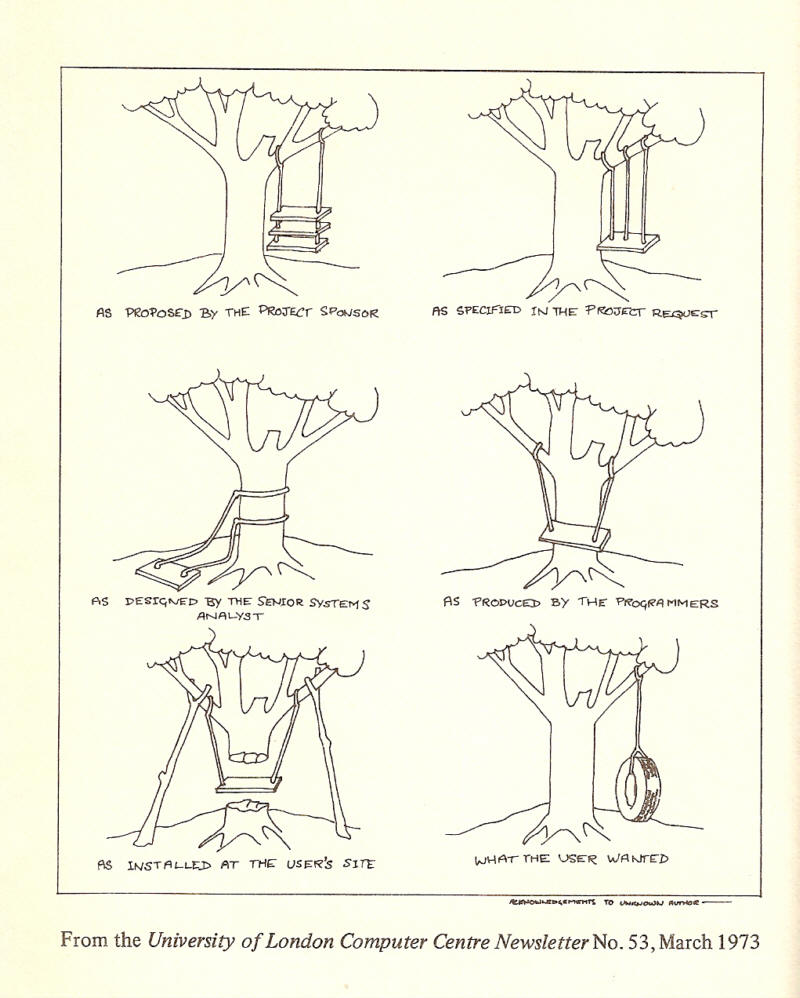
What is more shocking? That you have seen this in action or the publication date is March, 1973? Why are these communication problems still happening now?
As said before, programming is a social activity and communication is key in achieving your goals. The Agile manifesto is especially keen on this one. However, getting disparate people to work together can be a challenge especially if the goals are unclear. Communication does not have to be oral: writing good documentation is a sign of good software (DORA 2024).
Everyone has memories of drama associated with software: from bad specifications, to unrealistic timelines, via brittle code, and deployment catastrophes ending with working 12 hours days on weekend. All new (and old) software methodologies claim to help, but do they?
As Brooks said in his seminal work The Mythical Man-Month, there is no silver bullet. Scrum will be perfect for some teams and utterly destructive in others. Lean and Kanban work really well for some processes and get unwieldy for others. Nowadays, shift left is the buzz word merging operations and security with development: DevOps and DevSecOps. What will work for your company will be something unique.
Are the two problems above enough for your vision to be achieved? They do help and are necessary, but not sufficient. There’s always more…
Google has pushed OKRs as way to get everyone to follow the same vision. There are other alternatives from BUPs (Bottom-Up Priorities) to SMART and the simplest are generally the best. The patterns are the same: measure the things you want to change, evaluate new things, and see how the metrics change. Now, enters Goodhart's law: “Any observed statistical regularity will tend to collapse once pressure is placed upon it for control purposes”. Regardless of the method, the important bit to get your vision across.
All of these questions, and more, are under our foundation of people.
Imagine, if you will, a day when all the drama is removed from your software production: no panic, no crisis, just smooth software releases that exceed your customer’s expectations. This is what we have done in the past and can do for you.
We have the experience to guide you through a transformation towards team structures that accelerates progress, give staff clear areas of responsibility, and ensures all aspects of the work are someone’s core task. Be that a well recognised Agile pattern or something more bespoke, our understanding of the abstract factors that we can create the right approach for you.
This is part of a series on all our foundations. Here are links to the next entries:
 People, this post.
 Development next week.
 Security in two weeks.
 Operations in three weeks.
 AI in four weeks.
Dr Yann Golanski PEOPLE
people leader leadership culture processes stratgey organisation